News
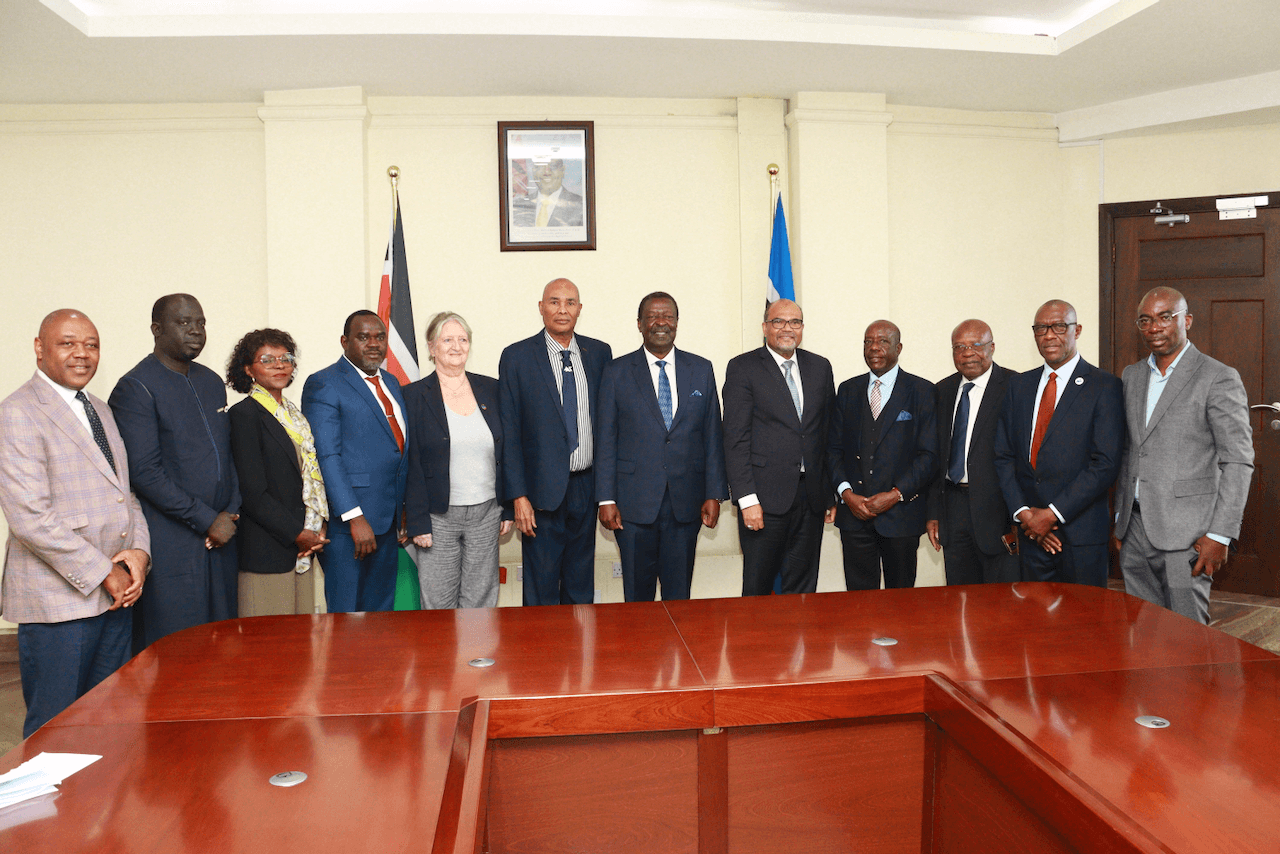
The Government of Kenya and the African Academy of Sciences have reaffirmed their commitment to placing science, technology and innovation at the centre of Africa’s economic and social transformation.The commitment followed high-level engagements between the newly constituted AAS Governing Council and senior Government officials, including the Prime Cabinet Secretary and Cabinet Secretary for Foreign and Diaspora Affairs, H.E. Dr Musalia Mudavadi, and the Principal Secretary for the State Department for Science, Research and Innovation, Professor Shaukat Abdulrazak.
The AAS delegation was led by the Academy’s President, Professor Friday Okonofua, and Executive Director, Dr Stephen Mutwiwa. The engagements marked the beginning of the Governing Council’s 2026–2029 term and provided an opportunity to strengthen cooperation between the Academy, Kenya and the wider African continent.
H.E. Dr Mudavadi welcomed the Governing Council and acknowledged the significant scientific knowledge, leadership and regional representation embodied within the Academy. He reaffirmed the Government of Kenya’s support for AAS, noting that Kenya was proud to host a continental institution serving scientists, governments and communities across Africa. The Prime Cabinet Secretary emphasized that governments are frequently required to make complex policy decisions without sufficient access to timely scientific evidence. He said stronger collaboration with AAS and its Fellows would help bridge the gap between research, public policy and political decision-making. He noted, that Kenya is strengthening the role of science, research and innovation in national planning and evidence-informed policymaking. Emerging national mechanisms for economic and social policy coordination would require credible research, data and scientific advisory support.
Through its multidisciplinary network of nearly 800 Fellows, AAS is well positioned to support African governments with scientific advice, policy analysis and evidence on priority areas including health, food security, climate change, energy, education, technology and industrialization.
Professor Abdulrazak further outlined Kenya’s ambition to increase domestic expenditure on research and development from approximately 0.7 per cent towards the continental target of one per cent of gross domestic product. He emphasised that stronger domestic financing was essential for reducing excessive dependence on external funding and enabling African countries to determine their own research priorities. International partnerships would remain important, but Africa must invest more of its own resources in scientific institutions, infrastructure and talent to achieve greater research sovereignty.
Professor Abdulrazak also called for a stronger connection between research, innovation and economic transformation. Scientific work, he said, should not end with academic publications or remain confined to laboratories and universities. It must generate products, technologies, enterprises, employment and practical solutions to societal challenges. Achieving this shift will require stronger partnerships between government, academia, industry, investors and communities. It will also require greater support for intellectual property protection, research commercialization, innovation hubs and science-based enterprises.
Professor Okonofua expressed the Academy’s appreciation for the longstanding support extended by the Government and people of Kenya. He described AAS as an accessible pool of African scientific expertise that governments could draw upon to support national development and continental transformation. “Science offers Africa one of its greatest opportunities for transforming economies and improving lives,” Professor Okonofua said. “The Academy will mobilise African scientists to address the continent’s development challenges and ensure that African knowledge contributes directly to African solutions.”
He stressed that the Academy was committed to science for development and to strengthening Africa’s ownership of its scientific agenda. African scientists, he said, must play a leading role in identifying research priorities, generating evidence and developing solutions suited to the continent’s realities. Global partnerships should be equitable, co-created and aligned with African priorities.
The meeting also highlighted the growing importance of science diplomacy. Kenya has increasingly become a platform for African leadership on climate action, green growth, development financing, regional integration and international cooperation. Scientific evidence will be essential in ensuring that Africa’s positions in global negotiations are informed by research generated on the continent.
Professor Okonofua commended President William Ruto for advancing African interests internationally and requested him to consider serving as a high-level champion for the Academy and African science.
The Academy also invited the Government to participate in the 16th AAS Scientific Conference and General Assembly, scheduled for December 2026 in Dar es Salaam, Tanzania. The conference will bring together African scientists, policymakers, innovators, industry leaders and development partners to discuss the role of science, technology and innovation in Africa’s transformation.