News
Could you briefly introduce yourself and share what inspired you to pursue a career in medicinal chemistry and nanotechnology?
I am an Associate Professor at the University of Kinshasa, honoured with awards like the SACI Postgraduate Medal, the Novartis Next Generation Scientist Award, and multiple DST/NRF Innovation scholarships. My journey began at Rhodes University, where I earned a Ph.D. in Chemistry by exploring nanoparticle systems for antimicrobial drug delivery. The passion I developed for nanotechnology arose from working alongside my late mentor, Prof. Rui MW Krause, whose curiosity and dedication to meaningful innovation had a profound influence on me. His guidance opened my eyes to the transformative potential of merging chemistry and engineering at the nanoscale to address pressing healthcare issues. My commitment to this path grew stronger during my postdoctoral work at the University of California, San Diego, where I focused on plant virus nanotechnology for COVID-19 vaccines and cancer therapies. These experiences not only shaped my scientific outlook but also revealed how nanotechnology can advance human health in resource-limited settings.
How did your background in nanoparticles for antimicrobial drug delivery influence your ARISE research on banana and plantain waste?
My early work on nanoparticle drug delivery taught me how potent yet costly conventional nanotechnologies can be, which limits their use in low- and middle-income regions. That realization guided me toward exploring more affordable, plant-based approaches. Bananas and plantains, being major food staples in tropical Africa, produce massive amounts of waste, often just fed to animals or used as fertilizer. Under the ARISE programme, I saw a chance to repurpose this overlooked biomass by using green nanoengineering tools to extract and convert valuable metabolites into antimicrobial and wound-healing agents. Working on antimicrobial nanoparticles in the past made it clear that reimagining abundant agricultural waste as raw material for advanced medical solutions could be both cost-effective and sustainable. This approach not only builds on my nanoparticle expertise but also seeks to provide direct benefits to communities that rely on these crops.
Could you explain the current scope of your ARISE project and any notable progress you have made in converting banana and plantain waste into medical applications?
My ARISE project, titled “Antimicrobial Biogenic Nanocomposite Formulations from Banana and Plantain Plants (Musa spp.)”, focuses on transforming banana and plantain waste into products that can help control microbial infections, sanitize surfaces, and promote wound healing. We have tested biogenic nanoparticles derived from banana extracts and isolated plant metabolites with encouraging antimicrobial effects. We have also standardized the quality attributes of these biogenic particles to ensure reliability. A key highlight of our work is the use of raw banana saponins, which naturally self-assemble into nano-micelles and have shown a remarkable ability to encapsulate antimicrobial agents. This green nanoengineering approach has revealed superior antimicrobial properties compared to unprocessed extracts or metallic nanoparticles alone, and we have even produced magnetic and porous materials with potential for water purification.
What are the most significant breakthroughs in your research so far, and how might these discoveries address public health challenges?
One breakthrough is the discovery that saponin fractions from banana waste, once nanoformulated, can encapsulate poorly water-soluble drugs with greater efficiency and reduced toxicity. This finding is especially important for diseases that require higher therapeutic concentrations or long treatment times, as it can enhance efficacy while minimizing adverse effects. Another breakthrough is our ability to isolate bioactive metabolites directly from green nanoengineered bananas. These metabolites, when paired with metallic nanoparticles, show heightened antimicrobial and wound-healing properties. Both discoveries directly tackle issues like antimicrobial resistance and lack of accessible medical resources. By harnessing local biodiversity and agricultural by-products, we open a path to affordable yet powerful solutions for infection control, wound management, and possibly broader applications like water purification.
How do you see green nanoengineering tools shaping the future of medical applications in Africa, especially through banana waste?
Green nanoengineering allows us to tap into Africa’s abundant biodiversity and upcycle what would otherwise be agricultural waste into advanced medical materials. By redirecting banana and plantain by-products toward the fabrication of antimicrobial drugs, wound dressings, and disinfectants, we reduce dependence on expensive synthetic routes. This approach can promote local manufacturing, create new job opportunities in biotech, and support environmental sustainability. Moreover, the exceptional availability of bananas in tropical regions gives Africa a unique advantage, potentially positioning the continent as a leading source of plant-based nanomaterials. The ultimate goal is to devise cost-effective nanomedicines that cater to urgent healthcare needs, like overcoming antimicrobial resistance, while also stimulating African innovation and scientific leadership in nanotechnology.
How has the ARISE programme supported your research, and what do you consider the most rewarding aspect of your experience as an ARISE fellow?
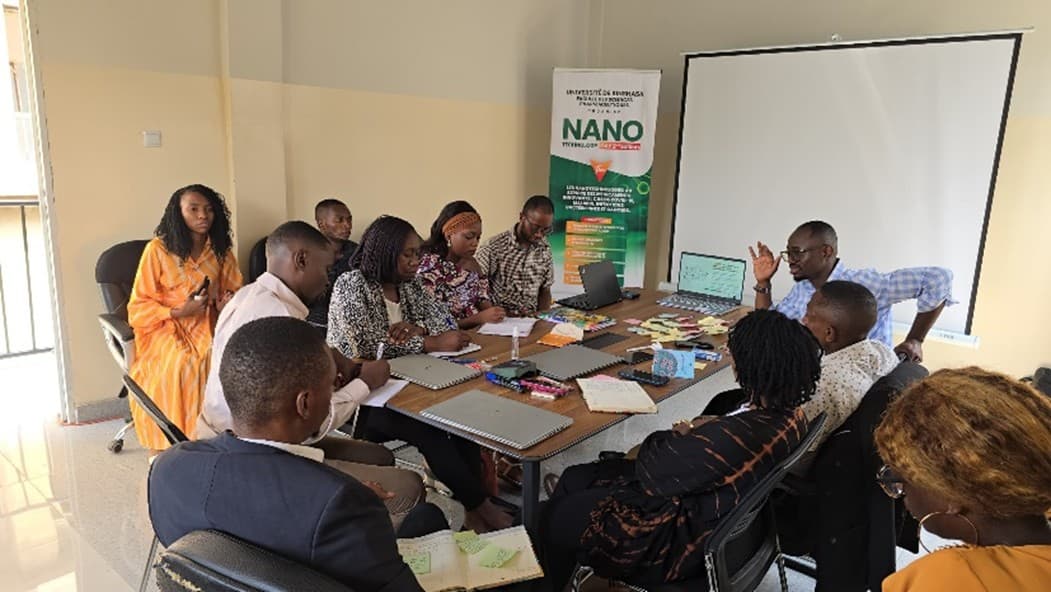
ARISE funding enabled me to establish the first Nanotechnology Lab at the University of Kinshasa and to create the Centre de Recherche en Nanotechnologies Appliquées aux Produits Naturels (CReNAPN). This has been instrumental in recruiting and mentoring graduate students in nanotechnology and medicinal chemistry, and in fostering collaborations that led to additional grants. Through these new research partnerships, we are now exploring plant-based nanoformulations for veterinary applications and working on a solar-powered water purification system. For me, the most fulfilling part of being an ARISE fellow is seeing how these efforts spark curiosity and encourage young scientists to embrace nanoscience as a tool for addressing local and global health challenges.
What advice would you give to young African scientists interested in research on nanotechnology and its applications for human health?
I believe it begins with genuine curiosity, hard work, and an unwavering commitment to your research goals. Nanotechnology can feel daunting, but perseverance and resourcefulness can unlock remarkable breakthroughs, especially when you look to local resources for inspiration. Seeking out mentors and building supportive networks is key, since multidisciplinary collaboration can amplify the impact of your work. Staying engaged with broader scientific communities, both in Africa and internationally, ensures that your research remains innovative and relevant. Finally, the pursuit of scientific excellence should be matched by a dedication to nurturing the next generation, because sharing knowledge and mentoring fellow researchers helps create a robust ecosystem for future discoveries.
Looking ahead, what are your aspirations for the future of your research, and how do you envision its impact on healthcare in Africa and beyond?
My immediate aim is to refine the use of banana waste to produce biogenic nanocomposites that address critical issues like antimicrobial resistance, wound infections, and clean water scarcity. I want to deepen our understanding of the molecular structures that make these plant-derived materials so versatile, ultimately translating them into tangible healthcare products for widespread use. As the research matures, I see Africa emerging as a major supplier of high-value nanoparticle raw materials, shifting global perceptions of the continent’s scientific capabilities. I also hope to train and inspire a new generation of African researchers who will push this field in exciting directions, thus further embedding nanoscience into the continent’s economic and scientific landscapes.