
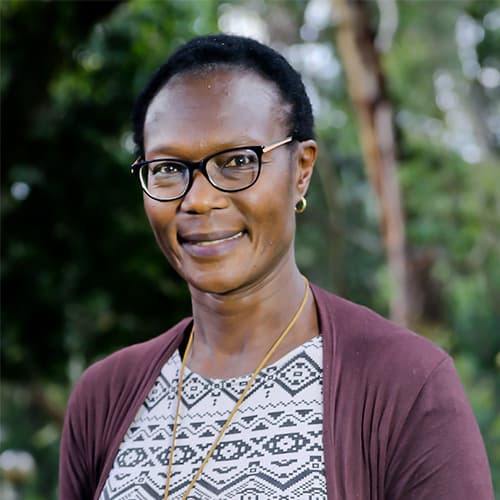
Omumbo Judith Atieno was elected as an AAS Fellow in 2012. As a fellow, Omumbo Judith Atieno contributes to the development of the Academy's strategic direction through participation in AAS activities and governance structures. This gears the Academy's vision of transforming African lives through science.
Country
Kenya
Year Elected
2012
Discipline
Medical & Health Sciences
Country
Kenya
Year Elected
2012
Discipline
Medical & Health Sciences
Dr Judith A. Omumbo holds a PhD from Oxford University, an MPH (Hebrew University, Israel) and a Bachelor’s degree in Dentistry (University of Nairobi). She began her career in epidemiology working as part of the KEMRI/Welcome Trust Collaborative Programme in Kenya. She was awarded a Welcome Prize studentship to undertake DPhil at the University of Oxford in modeling the spatial risks of Plasmodium falciparum in East Africa and completed her DPhil in 2005 after which she moved to the International Research Institute for Climate and Society (IRI) as an Associate Research Scientist with IRI’s Africa Program until 2011. Her research interests continue to involve building the capacity of the health sector in Africa to use climate information effectively for decision- making in the control of climate-sensitive diseases. She serves on the Scientific Advisory Committee of the World Wide Anti-malaria Resistance Network (WWARN) and the External Technical Advisory Group for AvecNet, a project on “Targeting malaria by hitting the vector” that is led by the Liverpool School of Tropical medicine and sponsored by the European Union. She has contributed significantly to the development of the use of maps and Geographic Information Systems to undertake the spatial and temporal distribution of malaria in Kenya and the Greater Horn of Africa over the past 15 years of her career. She serves as a technical advisor on malaria international program of the World Health Organization She has added her knowledge of climate information to capacity building initiatives she has led for the climate-sensitive disease control program in Eastern Africa. Dr Omumbo’s vision is for Africa to lead its own agenda or decision making for development needs and this will increasingly become the case as scientists from Africa extend their collaboration and receive recognition by peers in Africa for their achievements.Dr Judith A. Omumbo holds a PhD from Oxford University, an MPH (Hebrew University, Israel) and a Bachelor’s degree in Dentistry (University of Nairobi). She began her career in epidemiology working as part of the KEMRI/Welcome Trust Collaborative Programme in Kenya. She was awarded a Welcome Prize studentship to undertake DPhil at the University of Oxford in modeling the spatial risks of Plasmodium falciparum in East Africa and completed her DPhil in 2005 after which she moved to the International Research Institute for Climate and Society (IRI) as an Associate Research Scientist with IRI’s Africa Program until 2011. Her research interests continue to involve building the capacity of the health sector in Africa to use climate information effectively for decision- making in the control of climate-sensitive diseases. She serves on the Scientific Advisory Committee of the World Wide Anti-malaria Resistance Network (WWARN) and the External Technical Advisory Group for AvecNet, a project on “Targeting malaria by hitting the vector” that is led by the Liverpool School of Tropical medicine and sponsored by the European Union. She has contributed significantly to the development of the use of maps and Geographic Information Systems to undertake the spatial and temporal distribution of malaria in Kenya and the Greater Horn of Africa over the past 15 years of her career. She serves as a technical advisor on malaria international program of the World Health Organization She has added her knowledge of climate information to capacity building initiatives she has led for the climate-sensitive disease control program in Eastern Africa. Dr Omumbo’s vision is for Africa to lead its own agenda or decision making for development needs and this will increasingly become the case as scientists from Africa extend their collaboration and receive recognition by peers in Africa for their achievements.